For the first six months, breast milk alone gives a baby everything she needs — no water, no ghutti, no other food. Around six months, the baby is growing fast and her iron stores from birth start running low, so breast milk alone is no longer enough. This is when first foods, called complementary feeding, begin. Breastfeeding still continues alongside — up to two years and beyond.
Is my baby ready?
Most babies are ready at around six months. Signs to look for:
- She can hold her head steady and sit with a little support
- She watches you eat and opens her mouth when food comes near
- She no longer pushes every spoonful straight back out with her tongue
Starting much earlier is not better — before six months a baby's body is not ready, and food takes the place of breast milk she still needs. Starting much later is also a problem, because her need for iron and energy keeps rising.
How to start
- Begin with two or three small spoonfuls, once a day, at a time when she is awake and calm
- Make the food thick, not watery — it should stay on the spoon when you tilt it. Thin, runny food fills her small stomach with water
- Give one new food at a time and wait a few days before the next, so you can tell if something does not suit her
- Use a clean katori and spoon, or a cup, for her alone — not a feeding bottle, which is hard to keep clean
- Let her decide how much: she turns her head away or closes her mouth when she is full. Never force a spoonful
- Feed her sitting upright, sitting with her, without a phone or TV in front of her
- A new taste may be refused many times before she accepts it — keep offering, without pressure
How much and how often
These are approximate guides from WHO and Indian guidelines. Every baby is different; her hunger and her growth on the weight chart matter more than the exact amount.
Breastfeed as often as before; the food is added on top of breast milk, not in place of it.
First foods from your own kitchen
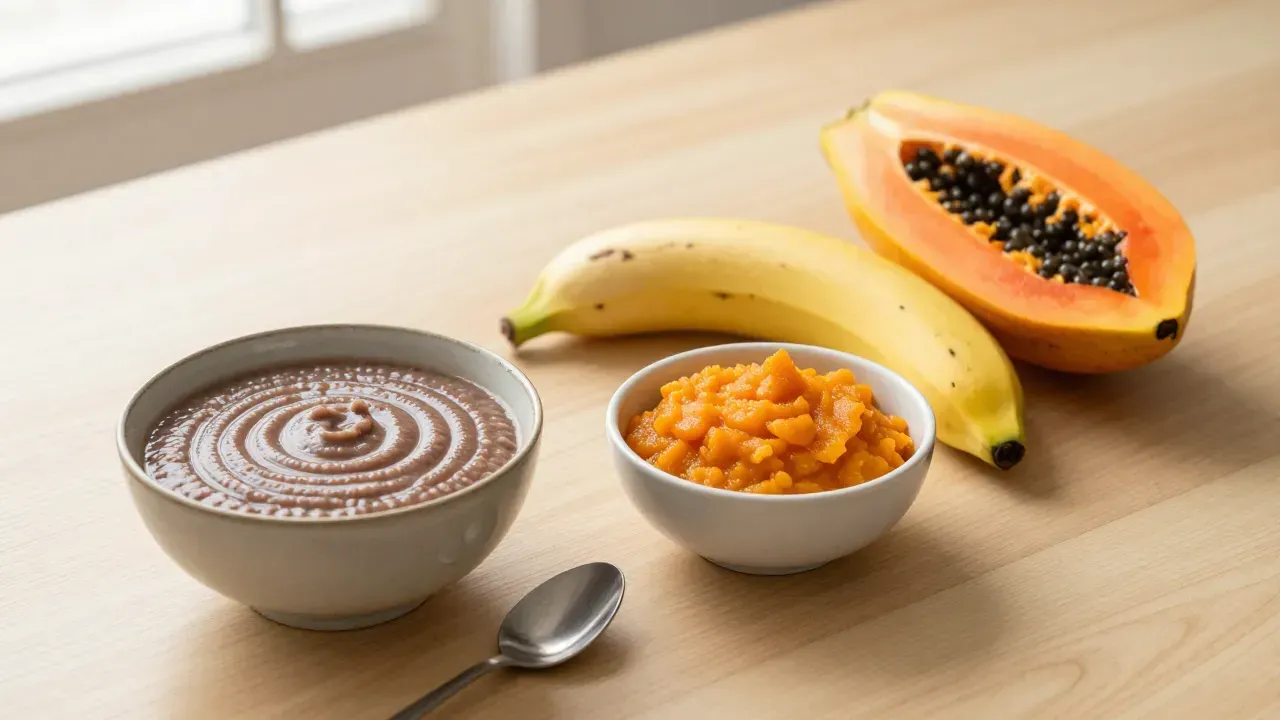
There is no need for packaged baby food. The foods your family already eats, cooked soft and mashed, are the best first foods.
As she grows, add a little mashed palak or other greens to her khichdi and dal, and offer foods of many colours. The app's Recipes section has khichdi recipes — for a baby, cook them softer, mash them, and leave out the salt and spices.
Iron, from the very first months
From six months a baby needs iron from her food. Build it into her meals every day:
- Ragi, dal and green leafy vegetables, mashed into her food
- Egg, if your family eats it
- A little mashed papaya or ripe mango with or after the meal, which helps the body take in iron from plant foods
Myths to leave behind
| Common belief | What is true |
|---|
Keep these away in the first year
- Honey — never before her first birthday; it can make babies seriously ill
- Added salt and sugar — none before one year; her food does not need them
- Cow's or buffalo milk as a drink in place of breast milk, before one year
- Tea, coffee, soft drinks and packaged juice
- Biscuits, namkeen, chips, instant noodles and other packaged snacks
- Whole nuts, whole grapes, popcorn and hard raw pieces — she can choke on them. Nuts are fine only as a fine powder mixed into her food
Clean and safe
- Wash your hands and hers with soap before every meal
- Cook fresh for her and feed it within an hour or two; do not keep her leftovers for the next meal
- Give her boiled and cooled water in small sips with meals from six months
- Stay with her while she eats, and never feed her lying down
Help that is already there
Your Anganwadi centre gives Take-Home Ration for children from six months to three years, and your ASHA worker can guide you on feeding. Your Mother and Child Protection (MCP) card has a feeding chart and a growth chart — take it to every check-up.
When to see a doctor
- Rash, swelling of lips or face, vomiting or trouble breathing after a new food — go to the hospital at once
- Loose motions or vomiting with fewer wet nappies, a dry mouth or a dull, sleepy baby
- She is not gaining weight, or her weight drops on the growth chart
- She refuses all food for several days
This is nutrition guidance, not medical advice. If your baby was born early, has a health condition, or your doctor has given you different advice, follow your doctor.